


Is 101Domain Better for Domains Than Hosting?
101Domain belongs on a shortlist for a reason that is easy to miss if you begin with server specifications. A company expanding into several markets may start by searching for one country-code domain, then discover a larger operational problem: registrations sit in different accounts, legal teams need defensive coverage, marketing wants localized names, and IT wants stronger control over critical domains. Add email, websites, security, and infrastructure, and the original registrar search becomes a decision about where the organization should manage its digital assets.
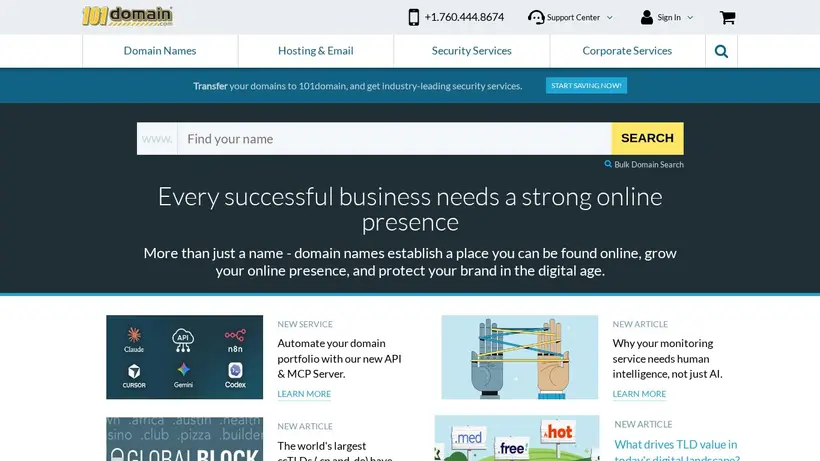
That tension defines this 101Domain review. The catalog brings together country-code, generic, and language domains with portfolio management, registry locks, defensive blocking, monitoring, enforcement, domain acquisition, and corporate brand services. Around that domain-centered core, 101Domain also lists VPS hosting, dedicated servers, a website builder, Gmail for Business, Cloudflare-related protection, web acceleration, and Solutions Engineering. The attraction is consolidation: fewer disconnected vendor conversations, a broader view of the domain portfolio, and adjacent services available as the organization grows.
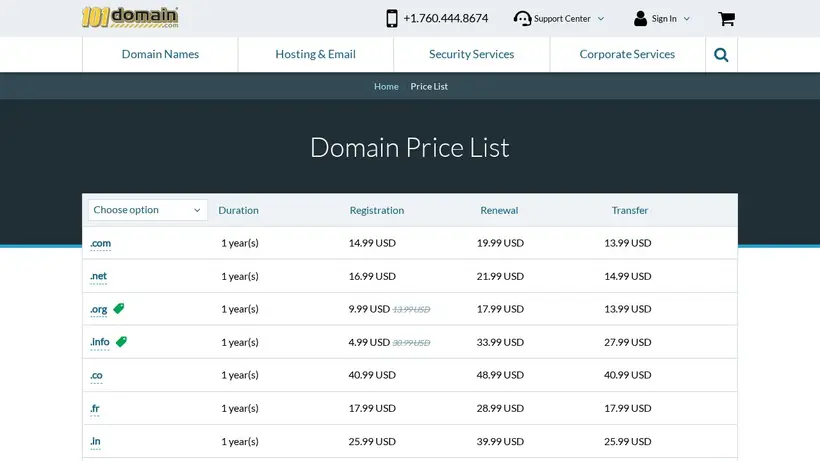
The hesitation is equally practical. A buyer evaluating infrastructure normally wants exact configurations, prices, billing terms, renewal costs, server locations, uptime commitments, and operational responsibilities before approving anything. Those details are not published here. The same visibility gap affects domain and managed-service budgeting because exact initial prices, renewals, setup charges, cancellation terms, and published cancellation terms conditions also need direct confirmation. This does not make the catalog less relevant; it changes how you should shop it.
For searchers landing here, the answer comes before the nuance: 101Domain makes the strongest case as an international domain and brand-management hub. It can also start a useful conversation about hosting, email, website tools, and web security, but those services should be judged through a scoped proposal rather than broad catalog descriptions. A domain operations team may see an obvious fit. A developer comparing VPS resources line by line will need more information first.
This review follows that buyer problem rather than pretending every product can be tested from a catalog page. The assessment uses the published service descriptions, plan groupings, and contact routes available for 101Domain. It does not claim hands-on server testing, measured uptime, checkout experience, private support interactions, or verified renewal behavior. That boundary matters: it lets us evaluate market fit and purchasing clarity without turning unpublished details into promises.
The sections below follow the same decision path. First, they explain where 101Domain sits between a conventional registrar, a hosting provider, and a corporate digital-asset vendor. Then they identify the buyers likely to benefit, the situations that deserve a pause, and the questions that turn an appealing catalog into a purchase-ready proposal. The short version? Choose the relationship around your primary problem. If international domain control leads, 101Domain deserves serious consideration. If hosting specifications lead, verify every technical and commercial term before committing.
Why Does 101Domain Make the Shortlist?
Picture a marketing manager preparing a launch in several countries. The obvious task is securing localized domain names. Within days, the project grows: legal asks about defensive registrations, security wants stronger transfer protection, leadership requests reporting, and the web team needs somewhere to build or host the campaign. The buyer is no longer asking, “Can I register a name?” The real question becomes, “Can one provider help us control the surrounding work without creating another operational maze?”
That is where 101Domain has a clear market position. Its identity centers on international domains, including country-code coverage, generic extensions, and language domains. It then extends into portfolio management and brand protection rather than stopping at registration. Registry Locks address domain hijacking risk. Portfolio-oriented services cover TMCH validation, defensive blocking, monitoring, and enforcement. Corporate brand services add brand monitoring, enforcement, management reporting, and domain acquisition. This is a wider proposition than a simple domain checkout.
International Coverage Solves the First Problem
A company entering another market often discovers that domain registration is not uniform. The desired extension may belong to a country-code system rather than a familiar generic extension. The organization may also need language-domain options or several related registrations to support local campaigns and defensive coverage. 101Domain explicitly organizes its domain offering around country-code, classic generic, newer generic, and language domains, while bulk domain search supports a broader discovery process.
The useful part is not a promise that every registration will be effortless. Registration requirements, eligibility, pricing, and renewal conditions still need checking for the domain being considered. The practical advantage is that international domain work sits at the center of the catalog rather than appearing as a minor extension of a hosting sale. That distinction matters when the portfolio spans markets and the buyer wants a provider prepared to discuss coverage beyond familiar generic names.
Consider a retail business exploring localized identities before a regional launch. Marketing may want the customer-facing domain, legal may want defensive variants, and leadership may want to know which names are unavailable or already controlled by another party. Bulk search can help organize discovery, while domain acquisition services may become relevant where a desired name is already held. These are separate tasks, not automatic parts of one registration. Still, finding them within the same broader service catalog can make the planning conversation more coherent.
A better way to read the “international domains” positioning is as an operational starting point. It tells you which problem 101Domain is built to discuss. It does not establish the price of a particular extension, its renewal cost, or every registration requirement. Ask for those terms before approval, especially when a launch depends on several names. A domain that looks available is only one line in the final decision. Ownership structure, renewal responsibility, access controls, and defensive coverage deserve attention too.
For a small buyer seeking one ordinary domain, this breadth may be more than necessary. For an organization coordinating names across countries, however, a broad international focus can reduce the search for separate specialists. The value rises with portfolio complexity. That is the first reason 101Domain earns a place on the shortlist.
Portfolio Protection Changes the Buying Question
The emotional shift usually comes after a domain becomes valuable. A name that once required little attention may later carry customer traffic, email, brand recognition, or access to a market. At that point, the team stops seeing it as a disposable registration and starts treating it as a controlled business asset. Who can change it? How is hijacking risk reduced? What happens when similar names appear? Who monitors potential misuse?
101Domain’s registry-lock offering directly addresses protection against domain hijacking. Its wider portfolio services include management, TMCH validation, defensive blocking, monitoring, and enforcement. Brand Protection expands the scope further through monitoring, enforcement, management reporting, and acquisition services. These offerings make the most sense for buyers who have moved beyond the “cheap domain” mindset and now need governance around multiple names.
Registration establishes control; portfolio services help maintain it. That separation matters. Registry Locks should not be assumed to be included with every registration. Monitoring is not the same as enforcement. Defensive blocking is not interchangeable with acquiring an existing domain. Each service addresses a different risk or operational goal, so buyers should ask for a scope that maps clearly to their portfolio.
A legal team, for example, may want monitoring across names connected to a brand. IT may care more about account permissions and registry-level protection. Marketing may need reporting that shows which domains support active campaigns. If all three teams use different language, the purchasing process can become frustrating. A sensible proposal should translate their concerns into named services, ownership rules, and expected outputs. What is monitored? Who receives reports? What triggers enforcement work? Which names are eligible for added protection? Clear answers prevent expensive assumptions later.
The breadth also supports a more mature portfolio strategy. Instead of reacting to each domain request separately, an organization can define selection, coverage, blocking, monitoring, and acquisition as parts of one policy. 101Domain presents services across that lifecycle. The appeal is less about collecting add-ons and more about creating a consistent operating model.
There is still a buying boundary. Exact pricing, billing periods, and package limits are not available here. A team cannot calculate the cost of protecting a portfolio merely from service names. The next step should be a scoped discussion identifying the number and type of assets, required services, renewal treatment, reporting expectations, and responsibilities. The catalog opens the door; the proposal must define the room.
Adjacent Services Create a Broader Hub
Once domain operations are centralized, the natural hope is that connected work becomes easier too. 101Domain supports that possibility with VPS hosting, dedicated servers, an Easy Website Builder, Gmail for Business, Protected Networks, Secure Web Accelerator, Cloudflare Enterprise, and Solutions Engineering. This creates a broader market position than either a registrar-only vendor or a specification-first hosting shop.
The catalog can appeal to a team that wants domains and nearby services under one commercial relationship. A new campaign may need a domain, a site-building route, professional email, and web protection. A larger organization may want portfolio services alongside infrastructure security, acceleration, or implementation help. One provider conversation can cover several connected needs. For a stretched operations team, that can feel like relief.
Yet consolidation should solve a real problem, not become a goal by itself. Buying every available service from one provider is not automatically simpler. The organization still needs to know where responsibility begins and ends. Gmail for Business confirms a professional email option, but buyers should verify the selected scope. The website builder confirms design and launch tooling, but its workflow and limits require direct review. Protected Networks mentions Cloudflare protection, infrastructure monitoring, and BEC protection, while Secure Web Accelerator focuses on performance, security, and reliability. Cloudflare Enterprise is presented as a custom plan. These are distinct offerings that should not blur into one vague promise of being “managed.”
Hosting requires the clearest separation. 101Domain lists scalable virtual servers and dedicated infrastructure, confirming that VPS and dedicated options exist. That does not reveal a purchase-ready configuration. A buyer still needs CPU, RAM, storage, bandwidth, operating system, location, management scope, backup arrangements, network terms, and uptime commitments. Without those details, the hosting listings function as conversation starters rather than comparable plans.
Imagine the same international launch moving from planning to production. The domain team may feel comfortable with portfolio control, while the development team asks where the application will run and who patches the server. The security team may ask whether Cloudflare-related protection is included or separately scoped. None of those questions undermines the benefit of consolidation. They ensure that consolidation has an operating model behind it.
The safer approach is modular. Begin with the service family that solves the primary problem. Add adjacent services only where ownership, scope, and cost are clearer than keeping the work elsewhere. A buyer centered on international domains may start with registration and portfolio management. A higher-risk organization may add registry locks or monitoring. Infrastructure can follow after a technical proposal satisfies the web team.
This is also where Solutions Engineering can matter. 101Domain presents that team for planning, implementation, and managed operations. An organization coordinating domains, web security, and infrastructure may value guided implementation rather than stitching together every handoff internally. The engagement scope and cost still need confirmation, but the availability of planning and implementation help supports the broader-hub positioning.
So why does 101Domain make the shortlist? Not because it publishes the most comparison-ready server table. It does not. The stronger reason is that international domain control, portfolio protection, and adjacent web services meet in one catalog. Buyers with that combined problem have a coherent starting point. Buyers with a narrower need should keep the scope narrow and judge the relevant service on its own terms.

Who Should Choose 101Domain—or Slow Down?
The hardest buying moment often arrives after the shortlist looks promising. A team likes the idea of consolidating domains, security, email, and infrastructure, but procurement asks for the full cost. IT asks for exact resources. Legal asks about protection and escalation. Nobody wants to reject a useful provider; nobody wants to sign around missing details either. The right response is not an automatic yes or no. It is a fit test.
101Domain is easiest to recommend when international domain operations lead the decision. Its case becomes more conditional as the purchase moves toward specification-led infrastructure. That does not mean hosting buyers should leave the shortlist. It means they should change the standard of proof. Domain breadth can be judged from the confirmed service catalog. A production server needs a precise configuration, commercial terms, and operational commitments.
Choose It When Domains Lead
The clearest buyer is an organization managing domain names across markets, extensions, or languages. That organization may need country-code registrations, generic domains, bulk search, portfolio management, registry protection, defensive blocking, monitoring, enforcement, or acquisition assistance. 101Domain groups these concerns around one domain-centered identity, making it a natural candidate for a consolidated portfolio discussion.
A fast-growing company provides a useful example. Early registrations may have been handled by local teams, agencies, or individual employees. As the business expands, fragmented ownership creates anxiety. Renewal notices reach the wrong inbox. Brand teams cannot see every defensive name. Security policies vary between accounts. The immediate need is not another isolated registration; it is a clearer center of control.
101Domain’s Domain Name Services and Portfolio Protection offerings align with that need. Registry Locks can add protection against hijacking. Brand Protection can extend the conversation into monitoring, enforcement, reporting, and acquisition. The buyer should still confirm which services apply to which assets, but the catalog supports a portfolio-level rather than transaction-level approach.
This fit is strongest where several internal stakeholders share responsibility. Legal can define brand-defense requirements. Marketing can identify market and language needs. IT can define access and security expectations. Procurement can request an itemized commercial proposal. Bringing those requirements into one scoped discussion may be more useful than asking each team to purchase separately.
The same logic applies to organizations concerned with brand exposure. A business that depends heavily on its name may value monitoring and defensive services even if its hosting remains elsewhere. 101Domain does not need to host every website to be useful as the domain and brand-control layer. That is an important purchasing option because it avoids forcing an all-or-nothing consolidation.
Choose it, then, when the primary goal sounds like one of these: coordinate international registrations, create portfolio governance, strengthen protection around critical domains, monitor brand-related domain activity, or reduce fragmented domain administration. Ask for a proposal that names each service, covered asset, responsibility, billing term, and renewal condition. If those answers are clear, the catalog breadth becomes operationally meaningful rather than merely impressive.
Consider It for Connected Web Services
A second buyer wants more than domain management but still sees domains as the anchor. Perhaps a small team wants a domain, a website-building route, and professional email. Perhaps a corporate group wants portfolio control beside web acceleration and infrastructure security. Perhaps an implementation project needs planning help. 101Domain can remain relevant because those adjacent categories are present.
The useful question is not, “Can I buy everything here?” It is, “Which connected services genuinely reduce handoffs?” A website builder may help a buyer who values a direct route from domain selection to site launch. Gmail for Business may align email with the organization’s domain work. Protected Networks, Secure Web Accelerator, and Cloudflare Enterprise may interest teams seeking web protection or performance-related services. Solutions Engineering may help where planning, implementation, and managed operations cross internal boundaries.
Consolidation works when responsibility becomes clearer. If one provider relationship reduces repeated account verification, fragmented procurement, or unclear escalation, that is a real advantage. If it simply bundles unrelated services without defining ownership, the convenience is mostly cosmetic.
Before combining services, build a short responsibility map. Identify who controls DNS and registrations. Confirm who configures the website or server. Define who handles updates, backups, monitoring, and incident escalation. Ask whether security and acceleration services are included in the proposal or quoted separately. Establish how email support differs from domain or infrastructure support. This exercise may feel bureaucratic during an exciting launch, but it prevents the familiar post-purchase question: “We thought they handled that.”
The broad catalog can also support staged adoption. A company might begin with domains and registry protection, then add monitoring when the portfolio becomes more valuable. Another might use the website builder for a simple launch before considering more involved infrastructure. A larger organization could discuss Cloudflare Enterprise or Solutions Engineering as separately scoped projects. Growth does not require buying the entire catalog on day one.
That staged approach keeps each decision understandable without inventing a trial or cancellation promise. No published cancellation terms window or published cancellation terms guarantee is published here, so buyers should obtain cancellation and published cancellation terms conditions directly before payment. Starting with a clearly bounded service may still reduce operational uncertainty because expectations are easier to document. Expand only when the first scope works as intended.
Slow Down When Infrastructure Leads
The buyer who should pause is not necessarily the buyer who should reject 101Domain. It is the buyer whose decision depends on server details unavailable in the current material. A developer choosing a VPS normally compares CPU, RAM, storage, bandwidth, operating system, location, management level, and price. A dedicated-server buyer may also need hardware configuration, network terms, provisioning details, and an uptime commitment. Those inputs are not published here.
That makes direct comparison impossible without a proposal. “Dedicated and scalable virtual servers” describes the VPS category but does not size a workload. “Reliable and powerful dedicated servers” presents the intended value but does not identify hardware or service terms. Web acceleration and Cloudflare-related offerings may support performance and security goals, but buyers need to know which service is attached to the proposed architecture.
Suppose an agency needs infrastructure for several client sites. The team cannot responsibly choose from a category label alone. It needs to estimate workload capacity, storage growth, traffic allowances, administrative burden, and recovery responsibilities. Where will the server be located? Which operating system is available? Who handles patches? Are backups included? What happens if a resource limit is reached? What uptime terms apply? Every answer should be tied to the exact quoted configuration.
Datacenter locations deserve particular care. 101Domain’s international domain coverage references world regions, but those regions describe domain availability rather than server locations. They should not be used to infer where VPS or dedicated infrastructure runs. If latency, residency, or regional deployment matters, request the specific facility location and relevant network details before ordering.
Uptime requires the same discipline. No uptime measurement or SLA is published here. Buyers should not convert general language about reliability into a percentage or contractual commitment. Ask whether the proposed service has an uptime target, what components it covers, how downtime is measured, and what remedy applies. A critical production workload may require those answers before procurement can proceed.
Operational scope can be just as significant as hardware. The presence of Solutions Engineering indicates planning, implementation, and managed-operations assistance, but it does not prove that every VPS or dedicated server is managed. Confirm who installs software, applies security updates, monitors the system, restores backups, responds to incidents, and assists with migration. If the internal team expects “managed” help, place each expected task in writing.
Pricing adds one more checkpoint. Exact server prices, billing periods, setup charges, and renewals are not available here. A quote should connect cost to resources and service scope, then distinguish recurring charges from one-time work. No published cancellation terms or published cancellation terms window is published, so ask about cancellation and published cancellation terms conditions before treating the service as reversible.
The punchline is simple: hosting buyers need a specification, not a slogan. 101Domain may provide a suitable proposal, especially for an organization already interested in its domain and security services. Until that proposal exists, however, the infrastructure offering should remain on the shortlist rather than move directly to checkout.
Use a Written Pre-Purchase Checklist
A good buying process should lower anxiety, not turn every missing detail into suspicion. The fastest route is a written checklist tailored to the primary service. This gives 101Domain a fair opportunity to define the offer while protecting the buyer from assumptions.
For domain registration and portfolio work, request the exact registration and renewal price for each relevant extension. Confirm eligibility or documentation requirements where applicable. Identify account ownership, authorized contacts, renewal handling, transfer procedures, and access controls. If registry locks are involved, ask which domains qualify and how authorized changes are processed. For monitoring, enforcement, defensive blocking, reporting, or acquisition, request a scope that names the covered assets, deliverables, responsibilities, and billing basis.
For website building or business email, ask what the selected service includes, how setup works, which limits apply, and what support path handles problems. Do not infer editor capabilities, templates, mailbox terms, migration services, or included extras from the category name. A short product walkthrough can answer more than a long list of assumptions.
For Protected Networks, Secure Web Accelerator, or Cloudflare Enterprise, define the desired outcome first. Is the goal web protection, performance improvement, infrastructure monitoring, BEC protection, or a broader enterprise deployment? Ask which components are included, who configures them, what ongoing management is provided, and how the custom scope is priced. This prevents several related security labels from being treated as one interchangeable package.
For VPS or dedicated infrastructure, request the complete configuration: processor allocation, memory, storage type and capacity, bandwidth terms, operating-system options, server location, network details, management responsibilities, backups, migration help, provisioning process, support entitlement, uptime terms, billing period, setup fees, renewal treatment, cancellation conditions, and published cancellation terms policy. If a web-acceleration or security service is recommended, ask whether it is included or separately charged.
Support expectations should also be explicit. 101Domain lists a Support Center, support tickets, a Knowledge Base, a contact option, and +1.760.444.8674. Those routes provide several places to begin. Critical-service buyers should additionally confirm operating hours, expected response handling, escalation procedures, and which channel applies to the purchased service. A listed phone number confirms a contact route; it should not be interpreted as continuous availability without confirmation.
Finally, compare the proposal against the outcome rather than the number of catalog items. A domain portfolio team may value coordinated coverage, protection, and reporting. A small site owner may need only a domain and straightforward launch tool. An infrastructure team may prioritize transparent resources and contractual operating terms. The “best value” differs because the underlying jobs differ.
If you are comparing options, resist forcing 101Domain into the wrong category. It is not presented most convincingly as a bare server-spec marketplace. Its more distinctive position joins international domains, portfolio control, brand protection, and adjacent web services. That positioning can be highly useful for the right organization, even if some infrastructure remains elsewhere.
Choose 101Domain when international domain control and brand protection lead the decision. Consider its connected email, website, security, engineering, and infrastructure services where they reduce meaningful handoffs. Slow down when exact prices, renewals, server resources, locations, uptime terms, cancellation conditions, or published cancellation terms terms determine the purchase. Then request a written proposal and decide from the confirmed scope.
That resolves the original buyer tension. You do not need to dismiss the convenience of a broad provider, nor do you need to approve an undefined commitment. Use 101Domain as the domain-centered hub when that matches the job. Treat every adjacent infrastructure service as a separate, documented decision. Confidence comes from choosing the right scope—not from pretending every unanswered question has already been settled.