

Breaking Down Cwcs VPS Plans, Pricing Terms, and Fit
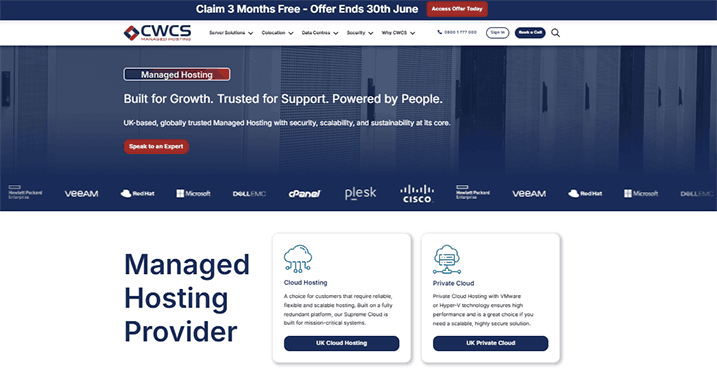
A buyer comparing Cwcs with a low-cost VPS host and a larger managed cloud provider is probably not asking only one question. The real question is quieter: “Who will help if this move goes wrong?” That is where this Cwcs review becomes more interesting than a simple price check. Supplied evidence positions Cwcs as a UK-based managed hosting and data centre services provider, with cloud hosting, Linux VPS hosting, dedicated servers, colocation, security services, domain hosting, and email-related services. That mix points toward business hosting, not disposable side-project hosting.
Picture a small agency moving client sites, an ecommerce team worried about checkout stability, or a software company that has outgrown bargain hosting but does not want to build an infrastructure team. Cwcs speaks to that buyer with UK-based engineers, ISO-certified UK data centres, migration help, monitoring, backup and restore language, DDoS protection, and several paths from VPS to cloud to dedicated servers. The promise is not “cheapest server.” It is “less lonely infrastructure.”
Evidence also sets clear boundaries. Linux VPS pricing is published in GBP, which helps quick comparison. Cloud hosting configurations show CPU, RAM, and storage, but use Request Quote rather than public fixed prices. Managed dedicated servers start from £159.00 per month in supplied evidence, while GPU server hosting starts from £650/month for entry-level L4 inference. Terms evidence says prices are exclusive of VAT, payment may be monthly or yearly, accounts renew unless closure notice has already been given, and Cwcs gives 30 days prior written notice before varying monthly or yearly amounts. Refund evidence is blunt: Cwcs does not offer refunds for unused service portions, and money-back guarantee is not published in supplied evidence.
So buying path is not “click first, think later.” Better path: decide whether you need UK data residency, managed help, migration support, and predictable infrastructure enough to accept quote-led buying for some services. Then compare public VPS plans, cloud sizing, dedicated server needs, support scope, billing terms, and cancellation rules. That is where Cwcs makes sense: not as a hype host, but as a guided UK hosting partner for teams that want humans close to infrastructure.
Review methodology: this Cwcs review uses supplied evidence only. We weighed published plan data, supported locations, support channels, migration claims, uptime/SLA language, refund terms, billing notes, and missing evidence. We did not use independent benchmark results, unpublished prices, unsupported global location claims, or invented buyer testimonials.
Why Buyers Put Cwcs on Shortlist
The typical Cwcs buyer is not casually browsing hosting coupons at midnight. More likely, someone has been burned before: slow ticket replies, unclear migration steps, surprise resource limits, or a host that was fine until real business traffic arrived. In that moment, “cheap hosting” stops feeling clever. The safer question becomes: who can keep business systems running while still giving enough control to grow?
Cwcs earns attention because supplied evidence frames it around managed UK infrastructure. It is described as a UK-based managed hosting and data centre services provider supporting secure infrastructure, cloud hosting, dedicated servers, colocation, and cyber security services. Evidence also says Cwcs operates ISO-certified UK data centres and provides 24/7 access to experienced UK-based engineers. For buyers who handle UK customer data, regulated workloads, ecommerce stores, or client systems, that combination matters before any plan table does.
Best for: UK businesses that want managed hosting, UK data residency, access to UK-based engineers, and migration guidance. It also fits buyers moving from unmanaged hosting to VPS, cloud, or dedicated infrastructure where support and sizing advice matter. A solo developer might be comfortable with unmanaged VPS hosting and a command line. A retail team, agency, school, logistics platform, or SaaS operator may want something different: engineers who can advise on setup, support channels that do not disappear during stressful moments, and infrastructure options that can scale beyond one starter server. Cwcs is best understood through that managed-hosting lens.
UK Data Residency Narrows the Decision
Some hosting decisions become easier when geography matters. Supplied evidence supports UK-based, ISO-certified data centres and specific Cwcs data centre locations in Nottingham, Manchester, and London. Cloud hosting evidence says data stays within UK borders, with references to UK and GDPR standards. That gives Cwcs a clear identity for UK-facing buyers: keep hosting close to users, support, and compliance concerns.
This does not make Cwcs ideal for every global project. Evidence does not publish global data centre locations beyond the UK. If your audience is mainly in North America, Asia, or multiple regions with strict latency targets, you would need a separate discussion about performance architecture and content delivery. But for UK businesses, UK-based agencies, and organizations that want data residency clarity, the focus is useful. A narrow map can be strength when it matches buyer risk.
Think about professional services firm moving internal tools. They may care less about having server in several continents and more about keeping data inside UK borders, talking to UK-based engineers, and proving that infrastructure is not afterthought. In that scenario, Cwcs feels more relevant than global self-serve host with many locations but little managed context.
Managed Hosting Changes Buyer Psychology
Emotional difference between unmanaged and managed hosting appears during pressure. Server alert arrives. Site owner deletes something important. Checkout slows before campaign. Developer leaves. In those moments, buyers want more than dashboard. Cwcs evidence repeatedly points toward management: monitoring, security updates, firewall setup, backup and restore, performance checks, configuration help, and access to UK-based engineers.
That does not mean every task is automatically included in every product. Buyers still need to confirm support scope for exact plan, because supplied evidence includes several product families and quote-based options. But editorial read is clear: Cwcs is positioning itself around “managed,” “expert support,” and “people-first” hosting rather than bare-minimum infrastructure.
This matters for teams with limited technical staff. If your only technical person is also building features, answering customers, and fixing integrations, provider-side management can remove operational weight. Good hosting is not only about server specs; it is about fewer moments where your team feels stuck.
Support Channels Make It Feel Human
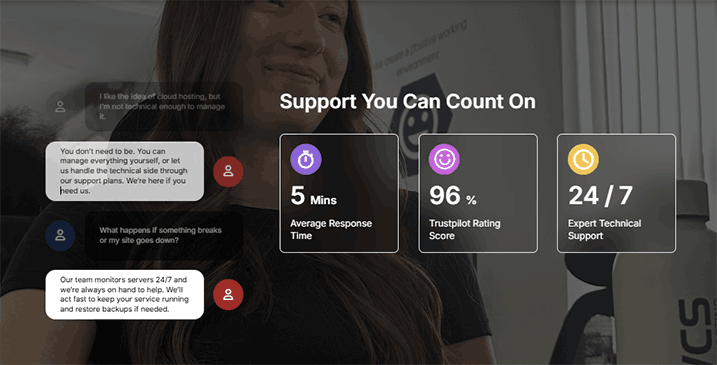
Cwcs support evidence includes 24/7 access to experienced UK-based engineers, 24/7 UK support, and cloud hosting support available by phone, ticket, or chat. Linux VPS evidence also says support team is on-site and available by phone 24/7/365. That channel mix matters because different problems create different emotions. Ticket is fine for routine configuration. Chat can help with quick direction. Phone feels important when business owner is staring at outage and wants person.
This human angle is central to Cwcs. Evidence does not provide verified independent support benchmarks, so it would be wrong to invent response times. But supported claim is still meaningful: Cwcs makes UK-based engineer access and multiple support routes part of its pitch. For managed hosting buyers, that is not side feature. It is one of reasons to choose provider at all.
There is also practical implication: before ordering, ask what exact support level applies to chosen plan. Is monitoring included? Are backups included? Is migration eligible at no extra cost? What is handled under managed support, and what is billed separately? Cwcs looks strong for support-led buying, but precise fit still depends on written scope.
How Cwcs Fits Real Hosting Scenarios
Hosting decisions become clearer when you stop asking “Is this good?” and start asking “Good for which job?” Cwcs buyer might be running WordPress-heavy agency, Magento store, SaaS platform, internal app, Linux VPS workload, or dedicated infrastructure with stricter isolation needs. Same provider, different risk profile. That is why Cwcs should be judged by use case, not only by cheapest entry price.
Supplied evidence gives several paths. Linux VPS has public monthly pricing and clear resources. Cloud hosting has scalable configurations with Request Quote. Dedicated servers offer tailored configurations and managed options. GPU hosting appears for AI and high-compute workloads, with evidence mentioning NVIDIA L4 24GB, L40S 48GB, and A100 40GB/80GB options, plus entry-level L4 inference server from £650 per month. Domain hosting starts from £7.49 for one year. This range means Cwcs can sit in several buyer conversations, but not all plans are equally self-serve.
Plan choice: choose Linux VPS when you want published monthly GBP pricing and known CPU/RAM/storage steps. Choose cloud hosting when your workload needs guided sizing, flexible resources, Linux or Windows options, or cPanel/Plesk availability. Choose managed dedicated servers when single-tenant resources, root/admin access, or tailored configuration matter. Choose GPU hosting only when AI or high-compute workload needs dedicated GPU infrastructure and monthly GBP billing is useful. Domain hosting belongs as add-on context, not main reason to choose Cwcs for infrastructure.
Growing VPS Buyers Get Clearer Pricing
Linux VPS plans are Cwcs’s cleanest comparison point because supplied evidence lists five monthly GBP prices with resources. VPS-L1-LIN is £19.99/month with 2 vCPU, 2 GB RAM, and 25 GB storage. VPS-L2-LIN is £29.99/month with 2 vCPU, 4 GB RAM, and 50 GB storage. VPS-L3-LIN is £49.99/month with 4 vCPU, 8 GB RAM, and 75 GB storage. VPS-L4-LIN is £69.99/month with 4 vCPU, 16 GB RAM, and 150 GB storage. VPS-L5-LIN is £89.99/month with 8 vCPU, 24 GB RAM, and 250 GB storage.
That spread gives buyers visible ladder. Small app, modest site portfolio, or development environment may start lower. Busier workload with more database activity may need more RAM and storage. Evidence also supports Linux VPS availability with operating system options including CentOS, Ubuntu, Debian, and Red Hat Enterprise, plus hosting control panels such as Plesk and cPanel. There is support evidence around 24/7 UK Linux VPS support, upstream DDoS mitigation, and free migration service references.
Caveat is lifecycle pricing. Supplied evidence does not publish full renewal pricing for each plan or setup fees. Terms also say prices are exclusive of VAT. So VPS table is good for first comparison, but buyer should confirm total monthly cost, VAT, support scope, control panel costs if optional, backup terms, and renewal expectations. Published entry pricing helps, but purchase clarity still requires due diligence.
Cloud Hosting Suits Guided Sizing
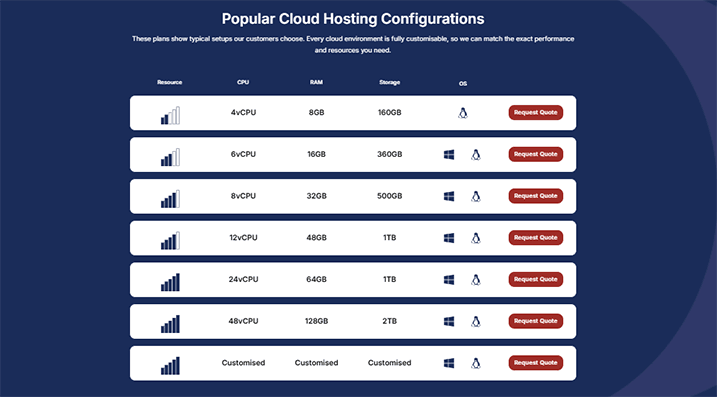
Cloud hosting evidence is more consultative. Supplied configurations include 4 vCPU, 8 GB RAM, and 160 GB storage; 6 vCPU, 16 GB RAM, and 360 GB storage; 8 vCPU, 32 GB RAM, and 500 GB storage; 12 vCPU, 48 GB RAM, and 1 TB storage; 24 vCPU, 64 GB RAM, and 1 TB storage; and 48 vCPU, 128 GB RAM, and 2 TB storage. Those rows use Request Quote rather than public prices.
That can frustrate buyer making quick spreadsheet. But it can also protect buyer from undersizing or oversizing. Cloud evidence says environments are fully customizable, can match performance and resources needed, and can upgrade RAM, storage, or CPU at any time. It also references Linux or Windows OS options, cPanel or Plesk availability, full root access if wanted, NVMe SAN storage with encryption at rest, and DDoS protection. For business moving more than brochure site, quote-led sizing may be sensible.
Imagine WooCommerce or Magento store planning seasonal campaigns. Buyer does not only need “some RAM.” They need capacity conversation, backup plan, migration path, security posture, and support expectations. Cwcs’s cloud story fits that buyer better than someone wanting instant anonymous checkout. Buying trade-off is speed versus guidance.
Dedicated Servers Match Control Needs
Dedicated server evidence is relevant when shared infrastructure feels too constrained. Supplied evidence says dedicated servers give exclusive CPU, RAM, and storage with no other tenants. It also says dedicated server solutions are tailored to exact requirements, with quote-based pricing depending on configuration, specifications, and support requirements. Managed dedicated servers are evidenced from £159.00 per month, and one supplied managed dedicated server configuration includes 4 cores, 32 GB RAM, and 500 GB storage, with full root or admin access.
This suits buyers who need isolation, predictable performance, or more control over operating system and control panel choices. Evidence supports range of hardware configurations, operating systems, management levels, and control panel options. It also references OS patching, security updates, proactive monitoring, and incident response in dedicated server context.
Digital agency hosting many client sites may like cPanel or Plesk workflows. Software team may want root/admin access and custom configuration. Business with heavier compliance concerns may value single-tenant resources. Cwcs gives plausible routes for all three, but buyers should not assume every dedicated setup costs from-price. Quote details matter: CPU model, RAM, storage type, backup retention, support level, bandwidth, control panel licensing, SLA terms, VAT, and cancellation terms.
GPU Hosting Serves Specialized Workloads
GPU hosting evidence pushes Cwcs into more specialized lane. Supplied evidence says dedicated GPU server hosting is designed for production AI workloads, with NVIDIA L4 24GB, NVIDIA L40S 48GB, and NVIDIA A100 40GB/80GB options referenced. It also says entry-level L4 inference server starts from £650 per month. Evidence states GPU server hosting is billed monthly in GBP with no hourly charges, no egress fees, and no dollar exchange rate surprises.
That last point is important for AI buyers. Cloud GPU costs can become hard to predict when hourly billing, egress, and exchange rates stack up. Cwcs positions GPU hosting around fixed monthly GBP pricing and UK data control. For company running private inference APIs, internal AI tools, or production AI workloads, that may be easier to budget than variable public cloud usage.
Still, this is not casual hosting. Buyers should ask for exact GPU model, CPU, RAM, storage, network, managed support scope, backup approach, security responsibilities, deployment help, and minimum term. Supplied evidence gives starting price and product direction, not full architecture. For AI workloads, Cwcs looks interesting when predictable UK-hosted infrastructure matters more than pay-as-you-go experimentation.