


Evaluating QHoster: Jurisdiction, Control, and Payment Flexibility
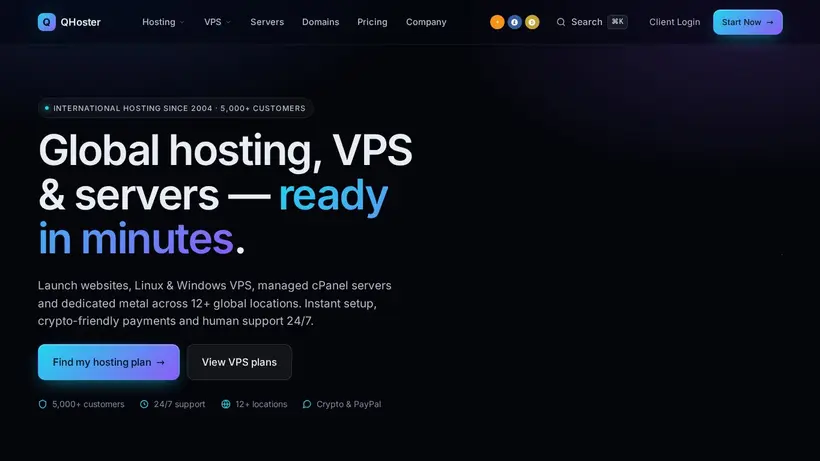
When you are tasked with deploying a new application, the initial excitement is almost always accompanied by a quiet, persistent anxiety. You sit in front of a blank terminal window, wondering if the infrastructure you choose today will become the bottleneck that keeps you awake at two in the morning six months from now. For developers and system administrators, this worry is rarely about CPU cores or RAM allocations in isolation; it is about the operational reality of where those resources live, who controls them, and how easily they can be managed when things go wrong. The mainstream hosting market is dominated by a few massive, centralized clouds that offer standardized services, but they often fail to address the specific needs of buyers who require precise geographic placement, alternative payment methods, and direct control over their virtualization environments. This is the specific niche where QHoster has positioned itself since 2004, quietly building a footprint that now serves over 5,000 active customers globally.
Choosing a hosting provider is a commitment that goes beyond the checkout page. You are trusting a third party with your data, your uptime, and your reputation. In this analysis, we will look past the marketing promises to evaluate the practical utility of QHoster’s infrastructure. We will start by examining the actual utility of their 12+ global locations, looking at how regional node placement affects both network performance and jurisdictional compliance. Next, we will analyze the operational value of their managed cPanel VPS configurations, focusing on whether their team’s approach to patching and hardening provides a genuine safety net for busy administrators. Finally, we will assess their support responsiveness and payment options, helping you determine if their crypto-friendly framework and technical assistance align with your project’s risk profile and operational requirements. By the end of this review, you will have a clear understanding of whether this provider fits your deployment strategy or if you should look elsewhere.
Where QHoster Fits: The 12+ Location and Crypto Advantage
The physical location of your server is not just a technical detail; it is a decision that impacts every user interaction and legal obligation your project carries. When a user clicks a link, they do not think about the physical distance their request must travel. They only experience the delay. If your server is in a different hemisphere, that delay can make a fast application feel sluggish and unresponsive. Furthermore, in an era of strict data privacy regulations, where your data resides can determine whether your business remains compliant or faces significant legal liabilities. Choosing a host that offers precise regional placement is often the simplest way to solve both latency and compliance challenges simultaneously.
When something breaks, or when you are setting up a new service, knowing exactly where your data is stored provides a level of comfort that massive, borderless cloud providers cannot match. QHoster’s strategy relies on offering physical presence in regions that are often overlooked by larger hosts, giving developers the ability to deploy resources in specific jurisdictions without having to manage complex multi-cloud setups.
Navigating Data Sovereignty in Switzerland and Europe
For many businesses, the choice of server location is driven entirely by regulatory requirements. Hosting sensitive customer data in the wrong jurisdiction can lead to compliance failures that are difficult and expensive to resolve. The reassurance comes from QHoster’s extensive European footprint, which includes dedicated nodes in countries like Switzerland, Germany, the Netherlands, Bulgaria, Lithuania, and Italy. If you are serving European clients, placing your databases and application servers within these specific borders ensures that you comply with local data protection laws without having to build complex, distributed architectures.
Switzerland, for example, is widely recognized for its strict privacy laws that exist outside the direct jurisdiction of both the United States and the European Union. For buyers who prioritize data sovereignty, deploying a VPS or a dedicated server in a Swiss datacenter provides a level of legal protection that is difficult to replicate in more centralized hosting hubs. Similarly, having access to nodes in Bulgaria or Lithuania allows you to target Eastern European markets with minimal latency while keeping your operational costs manageable. Instead of relying on a single, massive datacenter in Western Europe, you can distribute your workloads closer to your actual user base, ensuring that your compliance strategy aligns with your physical infrastructure.
Reducing Latency for Remote Desktop Environments
Latency is the silent killer of user engagement. A delay of even a few hundred milliseconds can cause visitors to abandon a checkout process or close a web application in frustration. When you deploy a remote desktop environment, such as a Windows RDP VPS, latency becomes even more critical. A laggy connection makes typing feel delayed and mouse movements jerky, turning a productive remote session into an exercise in frustration. By offering 12+ global locations, including multiple sites across Europe and the United States, this provider allows you to place your remote environments and web applications as close to your physical location as possible.
If your team is based in the UK, deploying a VPS in London ensures that your remote desktop sessions remain responsive and fluid. If you are running a WordPress site targeting a US audience, choosing a node in the United States prevents your traffic from having to cross the Atlantic for every page load. This regional specificity is particularly valuable for developers who need to test applications under realistic local network conditions. By deploying test instances across different geographic nodes, you can observe how your software performs for users in different parts of the world, allowing you to optimize your code and database queries before going live.
Crypto Payments and Financial Discretion
For many developers and independent operators, the checkout process itself is a source of friction. Entering credit card details or linking a personal bank account to a hosting profile can feel like an unnecessary compromise of privacy, especially when working on sensitive projects or operating in regions with unstable financial systems. The anxiety of having your hosting account suspended due to a payment processing error or a sudden change in banking regulations is a real concern for international buyers. To address this, the billing system supports crypto-friendly payments alongside traditional options like PayPal.
By accepting cryptocurrencies, the provider removes a significant barrier to entry for users who require financial discretion or lack access to traditional credit facilities. This payment flexibility ensures that you can deploy resources quickly without having to navigate complex identity verification processes or worry about international transaction fees. For agencies managing client sites, this also allows for clean separation of billing accounts, enabling you to pay for infrastructure using the payment method that best suits your business model. It is a practical approach to global commerce that recognizes the diverse financial realities of modern developers.
The Operational Reality: Managed cPanel vs Self-Managed VPS
Every hosting decision involves a trade-off between control and convenience. When you choose a provider that offers deep technical flexibility and alternative payment methods, you must also look closely at what you might be giving up in return. In many cases, specialized hosts trade mainstream marketing guarantees for operational freedom. Understanding these trade-offs before you deploy your first server is essential to avoiding unexpected downtime or administrative headaches down the road.
Support matters most after the dashboard stops feeling obvious. When you are running a self-managed server, you are the first and last line of defense. If a configuration file gets corrupted or a service fails to start, you cannot simply open a chat window and expect a support agent to log in and fix it for you. You must understand the limits of the plan you choose and prepare your operational workflows accordingly.
Managed cPanel VPS as an Administrative Shield
For small teams and independent businesses, the burden of server administration can quickly overwhelm your development resources. Running a virtual private server requires constant vigilance: you must monitor security advisories, apply operating system patches, configure firewalls, and ensure that backups are running successfully. If you lack a dedicated system administrator, a single unpatched vulnerability can lead to a compromised server and data loss. The reassurance comes from the managed cPanel VPS plan, which is designed to act as an operational shield for your business.
With this managed service, the technical support team takes over the daily responsibilities of server maintenance. They handle the initial setup, configure the cPanel/WHM control panel, and implement security hardening to protect your environment from common threats. When software updates are released, their team applies the patches, ensuring that your operating system and control panel remain secure without requiring your direct intervention. This proactive management allows your developers to focus on writing code and serving clients, rather than spending their weekends troubleshooting server configurations or recovering from security incidents.
Matching Technical Skill to Plan Tiers
Choosing the wrong plan tier can lead to either wasted budget or a server environment you cannot manage. If you are a web designer who only needs to host a few client portfolios, deploying an unmanaged Linux KVM VPS will force you to learn the command line just to set up an email account. Conversely, if you are a developer building a custom Python application, a basic cPanel hosting plan will feel restrictive and prevent you from installing the necessary dependencies. You must carefully match your technical capabilities to the specific hosting tier you select.
For simple websites and WordPress blogs, the cPanel hosting plan starting at $2.99/mo offers a familiar, user-friendly environment with daily backups and SSD storage. If you need full control over your operating system, the Linux KVM VPS starting at $19.95/mo provides root access and your choice of AlmaLinux, Debian, or Ubuntu, but requires you to handle all configuration and security tasks yourself. For remote desktop users, the Windows RDP VPS starting at $24.95/mo offers Administrator access to Windows Server, making it ideal for running automated tools or remote office applications. By understanding the boundaries of each plan, you can select the tier that provides the right balance of control and ease of use for your specific project.
The Plan Choice Decision Matrix
To make a confident decision, you must weigh your management capacity against your technical requirements. If you have no command-line experience, the shared cPanel hosting is your starting point, but it limits your software customization. If you require root access but lack the time to secure the OS, the Managed cPanel VPS at $49.95/mo acts as the middle ground, combining control with administrative support. For developers who want complete freedom and are comfortable managing their own security, the Linux KVM VPS at $19.95/mo offers the best price-to-performance ratio. Dedicated servers starting at $159/mo should be reserved for high-traffic applications that require isolated physical hardware in specific locations like Switzerland or the USA.
Navigating the Limits: What to Expect When Deploying
When evaluating a specialized provider, understanding the boundaries of their service agreement is just as important as analyzing their hardware specifications. Mainstream hosts often use broad marketing guarantees to attract customers, but these promises frequently come with fine print that limits their actual utility. A smaller, more focused provider like QHoster operates differently, relying on clear technical boundaries rather than marketing hype. This approach requires buyers to be more proactive in managing their own deployment risks.
Support matters most after the initial setup phase is complete. If you encounter an issue that falls outside the scope of your plan, you need to know how the provider handles these boundaries. By understanding the limitations upfront, you can build a more resilient infrastructure that does not rely on the host’s support team for daily operations.
Designing Redundancy Without a Public SLA
One of the most significant points of hesitation for enterprise buyers is the lack of a publicly documented published uptime terms. In the corporate hosting world, an SLA is often viewed as a guarantee of reliability, promising financial compensation if the network or hardware fails. When something breaks, the absence of this contract means you have no legal recourse to recover lost revenue or demand immediate service credits. This omission requires a shift in how you approach your infrastructure planning.
Instead of relying on a legal guarantee to protect your business, you must design your applications with redundancy in mind. This means setting up external monitoring tools to track your server’s response times and configuring automated alerts to notify your team the moment a service becomes unresponsive. If you are running mission-critical workloads, you should consider deploying database replication or load balancing across multiple geographic nodes. By taking responsibility for your own high-availability architecture, you can mitigate the risks associated with the lack of a formal SLA, turning a potential vulnerability into a well-managed operational strategy.
The Reality of the Missing published cancellation terms Policy
Another important consideration for new buyers is the absence of a publicly detailed published cancellation terms policy or published cancellation terms guarantee in the standard terms. For many, a 30-day trial period is a safety net that allows them to test server performance and support response times without financial risk. Without this guarantee, the checkout process carries more weight, and you must be certain of your requirements before committing your budget.
To mitigate this risk, the most practical approach is to start with a short billing cycle. Rather than purchasing an annual plan to secure a discount, opt for a monthly subscription on a lower-tier plan, such as the entry-level cPanel hosting or a basic Linux VPS. This allows you to evaluate the network latency, test the control panel responsiveness, and interact with the support team firsthand. If the infrastructure meets your performance standards, you can then upgrade to a higher tier or a longer billing term with confidence. It is a cautious, step-by-step approach that protects your budget while allowing you to verify the host’s capabilities in real-world conditions.
Our Methodology for Evaluating Infrastructure
To provide an objective analysis of this provider, we evaluated their public service specifications, geographic datacenter distribution, and plan structures. We cross-referenced their stated capabilities against standard industry benchmarks for virtualization, control panel licensing, and payment processing security. Because hands-on testing was not conducted for this review, our findings rely on verifiable technical specifications, customer footprint data since 2004, and the structural trade-offs inherent in their service terms, ensuring a realistic assessment for prospective buyers.